The goal of horror films is to scare the audience, as stated previously many times in older posts. As such, they must keep certain technical aspects in mind during film production that would convey a tone of fear or suspense. Horror films rely on other aspects that are not just camerawork, although it is an important factor in creating a terrifying scene. Today, I decided to look into the different aspects involved when creating a horror, and I'm hoping I can effectively incorporate these techniques in my opening so that anyone watching will feel like they are watching an actual Hollywood movie.
Editing
Editing is used to emphasize the horror of a certain scene in a film. For example, a film might use slow motion to create a paranormal theme. It also builds up fear for the audience, because the slow motion creates tension among them, as they are getting anxious for some sort of jump scare that may or may not happen.
The Final Girls (2015)
Fast paced scenes, like action movies, will create suspense and excitement from the fast shots filled with action. Because of how quick the scene is moving, it is difficult for the audience to predict what will happen next, building fear within them.
28 Days Later (2003)
Montage editing occurs when multiple shots are combined and assembled to play them into a sort of sequence. This allows the audience to understand the deeper meanings in the scenes of movies, rather than seeing single shots. An example of this would be in Saw I, when the man realizes how everything was connected within the "game". As the shots transition faster and faster, the viewers feel tense, as they see how the man's brain is quickly processing the events he went through.
Saw I (2003)
Minimal editing is, as the name states, when a scene has little to no editing done on it. This is so that the audience feels like what is occurring is realistic and could happen in the real world. They became more terrified because that means that what they are watching could be them in the future if they happen to be in those same circumstances.
The Descent (2005)
Sound (Diegetic and Non-diegetic)
Horror films use sounds that the viewers would be able to hear if they were in the scene, such as a doorbell ringing (diegetic), which makes the piece more realistic when we hear it. Sounds that can not be heard if you were there would include the background music playing over a scene (non-diegetic). This type makes can makes us feel tense or create adrenaline if the music is high pitched or fast respectively.
A scene where the villain pops out at an extremely unexpected moment is often accompanied with a loud noise that grabs the audiences' attention. This makes the scene more scary overall because the people watching will jump in surprise from the scene.
Sometimes scenes do not need sound to make it scarier. Sometimes, a scene is completely silent so that suspense is built, as silence is usually a good indicator that a jump scare will happen shortly. Other times, a simple sound such as a knock on the door will be heard, also making the audience feel startled.
A Quiet Place (2018)
Mise-en-scene
The color in horror films are also vital in instilling a sense of fear and anxiety within the audience. Everything that gives the scene its color, from the lighting to the props and costumes the actors wear is called mise-en-scene.
Lighting in horrors are commonly dimmed to create a feeling of the unknown and make the audience fearful of what is to come. Some parts will be completely pitch black, leaving the audience to interpret what is lurking in the darkness. Strobe lighting can also be implemented so that people can not fully see what is happening and brightness towards the end of the film can represent that the finale is coming to a close.
Props in a horror film can be weapons such as a knife or creepy dolls given to little children that make the audience feel uneasy or off. In a movie revolving someone trying to escape from a certain place, props in that movie would probably have cages, which would give off a fear of claustrophobia in some people. In a film where the setting is primarily located in a hospital would have hospital beds, needles, bags of bloods, etc. to give that hospital vibe and provide a sense of realism.
Costumes in a horror typically consist of the same getup. The villain almost always wears a creepy-looking mask to cover their faces and hide their true identity. The mask is also a dead giveaway to the viewers of who the antagonist is in the story. Other factors such as when a character has ripped, dirty, or just minimal clothing would be made to suggest that they are vulnerable and an easy target for the villain.
Horror films typically have a large cast of characters who got tormented by the evil villain throughout the film. They are picked apart one by one until the main character is the only one that remains for the "final confrontation". These groups of characters are often made up of different types of people. You have The Jock, The Cheerleader, The Nerd, The Stoner, The Token Minority, The Nice Guy, and then finally, The Last Survivor.
The Jock
The Jock archetype obviously is known in the film's world as the popular guy who participates in sports, has a beautiful girlfriend, is handsome, etc. They are also narcissistic towards the other characters, feels like they are the alpha male of the group, and not the smartest by a long shot. Most horror movies have The Jock die to the villain by trying to defeat it. To the women in the film, he is desired; to the men, he is envied. To the audience, we root for the antagonist when The Jock is confronted by it.
Cabin in the Woods (2011)
The Cheerleader
Basically The Jock as a female, The Cheerleader is pretty, popular, rude, and not smart. Her physical features is what allows the other characters to tolerate her attitude towards them. Like The Jock, the viewers often feel hate for The Cheerleader, and the villain can often finish her off with ease. In tense situations where the characters are in danger, this person is the most hysterical, screaming at the other people. They become terrified in their situation, as well as annoying to the people watching.
Friday the 13th (2009)
The Nerd/Stoner
If a horror movie has The Nerd as part of the group, you will most likely not see The Stoner, and vice versa. Both of the characters who fit in this archetype are complete outcasts from the group, mostly being a part of it due to them having a close relationship to the main character. Furthermore, they tend to be made fun of or mocked by The Jock or The Cheerleader, making it easy for the audience to relate to them. They also do not have to be smart, even if a title such as The Nerd would sound like they are. Unlike the two archetypes mentioned above, The Nerd/Stoner is not the best in terms of looks and have little athleticism, but they give the viewers some sort of comic relief. This is what makes them unique from the rest; whether they are intentional or not, this archetype makes the audience laugh in a genre that focuses on trying to make us frightened.
It (2017)
The Token Minority
A group in horror movies almost always have that one friend from another race to bring some diversity into the film. Unfortunately, these characters tend to be an afterthought for horror movie writers, as they are never really as developed as the other characters. The people watching the film do not really care for these characters, as they are probably going to be the first to perish anyways. Sometimes, this archetype can blend in with The Nerd/Stoner. However, if a character in this archetype understands they are a minority and that a serial killer would likely target them first, then that would result in them having a greater chance of not being the first to die.
Texas Chainsaw (2013)
The Nice Guy
Typically played by the main male character, The Nice Guy archetype can either be the brother, friend, or even love interest of the main girl character. Because of his kindness towards everyone, he is often friends with The Jock and liked by the people around him. He is the voice of reason in the group when situations turn south, making the audience see him as likeable and relatable. Sometimes, he makes it to the final conflict with the other main girl character, or he can be one of the last to die, giving the audience a tragic ending to the story. The Nice Guy can also be The Last Survivor.
It Follows (2014)
The Last Survivor
The Last Survivor, if you have not realized already, is the character that makes it the end of the movie. Occasionally The Nice Guy, this character could also be the main girl character. Pretty on the outside, she is also intelligent, kind, and liked by everyone in the group. Compared to everyone else, she is more innocent and pure, with her mind not clouded by anything such as drugs, which is why she makes it to the finale. She blends into the group at the beginning of the movie, but by the end she finds strength within herself that she never knew she had. Seeing everyone in the group be picked off one by one made her understand that she would be next if nothing is done. She makes the villain suffer the consequences of their actions or dies trying.
Camera angles are extremely vital in horror films. The different camera tricks that are used within a piece such as horror tricks the bodies of people to pump adrenaline into their system and make them afraid. Trying to produce reactions out of the audience when not correctly using the techniques about to be mentioned will more often than not result in the viewer being left disappointed at the scare attempt.
Establish Shot
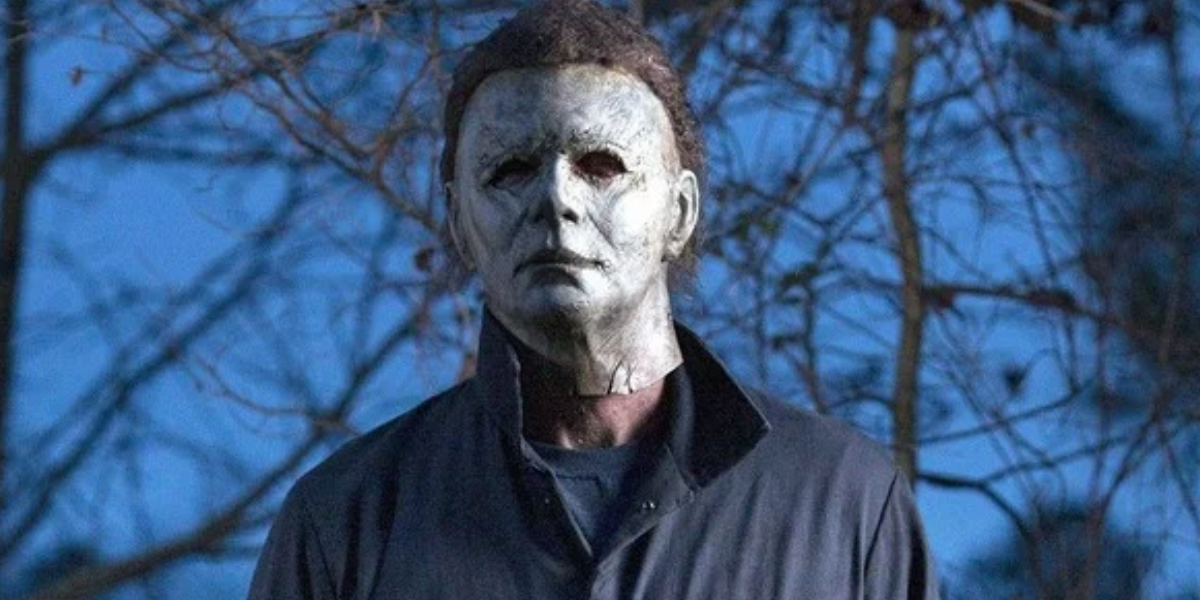
As everyone already knows, the establishing shot introduces the setting of the movie and the relationship it has between the main subjects. In horror films, there is usually some sort of prominent building or thing that is focused on in the shot. This would imply that whatever is being emphasized is either the source of the evil presence or is somehow cursed.
Establishing shot of Halloween (2018) implies that the man is evil
Close-Up Shot
In close-up shots, the shot is framed tightly on a specific subject, usually the face of a character in the story. When a character's face is focused on a close-up shot, the main purpose is to emphasize the reaction that they make. In horror movies, the close-up is either made to show the scared reaction from the main subject, with the purpose being to make the fear transition to the people watching. It can also be used to show the close-up of the monster or antagonist in the film to scare the audience.
Psycho (1960), showing the reaction of the subject as she is about to be stabbed
Point of View Shot
In the point of view shot, the scene is put into the perspective of the character so that the audience can experience whatever the subject is going through. In horror movies, the POV shot is often done when a character goes into a dark room or is alone in a forest at night, unable to properly see anything. Because of this, the audience is put into a position where they can be scared at any moment, because they are looking around the area to see if something will suddenly appear out of nowhere and scare them.
In Cloverfield (2008), multiple POV shots are effectively used here to portray the brutal attack
Pan Shots
Panning, or pan shots, is when the camera is moved horizontally from a set point to create a panorama. The intended effect is to make the audience feel like they are standing in one spot and looking from side to side. In horror, the pan shot allows the viewer to see the antagonist chase the victim or show someone being followed. Sometimes, the pan shot and close up are used together to reduce what the audience sees, and then when the camera pans to the left, they are surprised by the evil entity.
It Follows (2014) uses the panning shot in the opening scene to create a tone of suspense and fear
Based on this research, I want to incorporate at least 3 of the 4 shots mentioned above in order to scare my audience in the opening.
Having already decided the genre in my previous post, I was thinking up of different plots for my horror movie. Many horror movies have the main conflict of the story revolve around supernatural forces, urban legends, characters brought up from an evil origin, or simply monsters. Due to the low budget this film is going to have, as well as the resources I have at my disposable, making a film with my antagonist being some sort of supernatural being or monster is out of the picture. I need to build a story around a character who had a bad childhood which resulted in them turning into someone malicious or simply have them be born evil, like the infamous Michael Myers.
Generally, horror films use multiple methods within the piece to induce fear and suspense among the audience. In the openings of many horror films, at least one method is used to immerse the audience into the story and get them immediately hooked on the story. Usually, this is done by quickly introducing the antagonist in a fast-paced chase mixed in with some slow-paced sequences with a random person who more often than not, falls victim to the villain. Other times, the villain is introduced by only having a slow-paced shots, where the main subject (soon-to-be-victim) is slowly wandering around their environment, fearfully looking around the area, creating anticipation and anxiety within the audience that something is going to happen shortly. An example of this would be the opening to The Ring. The story starts off with the victim getting creepy messages and hints that she will die, which creates tension among the viewers. As the subject begins experiencing odd events at her house, they slowly walk around the house trying to return understand what is happening, before the girl from the tape walks out of the television and presumably kills the subject.
OVERVIEW
All horror movies tend to follow a specific plot, and in this case, I want to have one that falls under a low budget and is easy to produce. Some of the basic plots in this genre are when the main character (MC) moves into a new house and experiences supernatural events, the MC moves into a rural area and everyone living their turns the MC's life into an abyss of fear, an aggressive creature or alien of some kind begins terrorizing the area that MC lives in, or an ancient person or thing (such as a mummy, vampire, etc.) comes back from being dead and starts committing terrible acts. Many of these basic stories all follow the same formula where characters surrounding the MC are picked off one by one until only the MC remains by the end of the story. Furthermore, in many stories where the MC manages to beat the villain in the "finale", there is a little twist in the story where it is revealed that they are not defeated yet, and the MC, along with any remaining people, must do one final battle against the antagonist. Also, because the story is a horror, there are many films in this genre where the MC fails at the end of the story or it simply ends in an open-ended way. In other words, the audience has to decide for themselves whether the villain is able to return sometime or if they were beaten for good.
To create a story such as the ones explained above and increase the heart rates of the people watching, different techniques are used to manipulate the audience into giving some sort of reaction out of them. One such method that is used in many movies that I need to be sure to incorporate into my own piece is called negative space. In this technique, the frames of certain scenes remain still for a prolonged period of time, causing the audience to focus their attention on anything they see, such as a wall or an area completely submerged in darkness. This type of method where peoples' attention are focused on specific details of the setting makes them believe that something will come out of the area and scare them, which is what I need to emulate in my own piece. A great example of this technique being used would be in the original Blair Witch Project. Although we never see the witch in the film, the audience was glued to their seats in suspense as the main characters are terrorized by it throughout the piece. In the clip below, the main characters are wondering how a bunch of piled rocks arrived to their location, and the camera panning to random tree branches and bushes in the forest, which forced the audience to scan the area as well because in the back of their mind, there was a chance that the witch would suddenly appear in front of them.
Another technique used often would be the jump scare. This method is has been done in all the classic horror movies. A quick and abrupt change in the scene occurs, with a loud or creepy sound commonly accompanying it. They also appear when the scene in the film is completely silent and the audience has little to no expectation that anything scary could possibly happen, until it is too late. While many believe this style of horror to be lazy method of scaring the people watching, there have been films that effectively use it. An example would be James Wan's The Conjuring. In the clip below, James Wan creates a scene filled with silence and makes the audience know that something frightening will occur, yet executes the jump scare so successfully that people are still left surprised and shocked when it does appear.
If I am going to make a horror film opening, I need to utilize at least one of the above techniques to grab the viewer's attention, or else it would not be much of a scary movie.
After much debate between myself on what genre my project should be, I finally settled on producing an opening for a horror film. A horror is supposed to strike fear and suspense into the audience, and I feel like I have the necessary tools at my disposable to make my audience get that feeling. However, I should also focus on creating something enjoyable and original so that it sticks out from all the other horror film openings. I either need to make an opening that follows the usual ingredients for a horror film opening but be the best at it, or create something completely new within the category that would earn me a good score on the final exam.
One of the main reasons why I decided to choose horror for my genre was because of the current global situation and location. With COVID-19 plaguing the 2020-2021 school year, it has been and will be extremely difficult gathering people to help me in my projects. So, putting that into consideration, I figured a horror film would work best because not many people are required to make one; usually, a horror film opens up with someone being chased by another person or thing to introduce the audience to the main conflict. For my opening, I am planning on simply having someone be chased through a dark environment by a masked figure holding a knife or handgun. This means that I only need to have around 2 people help me film my opening, which is definitely workable. Furthermore, I want the location to consist mostly of trees and grass so that the audience feels like they are in the middle of nowhere in a forest. This is perfect because I live in an area where there is quite a bit of nature everywhere, and if I can not film in my neighborhood for whatever reason, I have already thought up of other places I can shoot my opening.
The only issue that I see becoming a problem later on if not addressed soon is the lighting. I want to film at night because the pitch-black setting would give viewers a sense of fear and suspense. Not being able to see anything would use the common motif of something lurking in the dark, which is what I want to evoke from my audience. However, I have to have some sort of lighting while filming so that the audience can still see the what is happening in the film or else they will just seeing nothing, which I can only assume is not entertaining. As such, I need to conduct research on easy methods that people in the horror industry use to produce good lighting within a film piece, and hopefully replicate it successfully in my own.
I honestly can not believe I am already at the final chapter of my time in AICE Media Studies AS. All the projects leading up to this moment have been preparing me for this moment. We have to make a 2 minute film opening, and the idea of doing it scares me to no end. However, this is worth an absurd amount of my Cambridge final grade, so I will do my best at achieving the desired grade.
The thing that worries me the most is the fact that I will be working on this project alone. Prior to this, all my previous projects were done with at least one other person, and they did their part in getting a good grade. So, the fact that I am working by myself means I am going to do a lot more work than usual and have to work on the parts that are my weakest, such as editing.
The good thing about having to do these blog post is that it means I can not procrastinate and do everything at the last minute. Like most normal people, I have usually done big assignments on the last week or day, not getting any sleep in that time. With this blog, my health will not be as bad as it usually is during the stressful times of April/May when Cambridge has all their tests and the SAT is around the corner. It is the little things that can be appreciated.
Right now, I am focusing on what the theme/genre of my project should be, as well as the plot of the story. Personally, I would love to go for a comedy, but I do not think I would do a good job of making an opening for one, so I want to go for something simpler. While I am still deciding, I am most likely going to choose horror, as I believe it will not be as hard as other genres and due to the fact that horror is one of my favorite types of movies.
One thing I will definitely do for this project is making a plan detailing what to research, common tropes in opening horror scenes, etc., which will vastly help in making the final product. Furthermore, I should look into sample student's projects so I know what Cambridge expects in the film. Hopefully by my next post I will have my genre decided so I can begin the research aspect of the project.
Before we could actually begin production, post-production, etc., we needed to discuss what song to do to represent our artist. After listening to the different songs and discussing for some time, we decided to do "Me and Your Mama". We listened to the song multiple times, then regrouped within our Team's breakout room and develop a plot for our music video, which ultimately wound up being about a heartbroken man furious after seeing his ex-girlfriend with another man. The beat switch at around two minutes made us brainstorm ideas on how we could use the different vibe and incorporate into our video to create something that would flow right with the sudden change in tone and emotion.
For research, we were given two charts that had four columns each, and we had to find different artists within the same music genre to do research on to serve as case studies. With eight total columns and four members, each member did two columns. Then, we created a layout sheet that helped us plan the different camera shots, angles, edits, and other elements for the video. We would each suggest certain techniques that would best fit into a specific part of our story. For example, one of us in the group thought about having a close-up shot of the single man's hand when he is crushing a can to symbolize his rage at seeing his ex-girlfriend happy with someone else. We all decided it was a good idea and it turned out great in the final version of the video.
With a plan for our video completed, we set up a date over the weekend where we would all meet up and produce the video. We went to our town center because it has a lot of different backgrounds that would help change the environment in our video. We found an area that was not too populated so we could take our masks off, as COVID-19 was making the video making process difficult. The area we were in had a lot of grass, a lake, and an overall peaceful scenery, so it worked out great for our video. As we were filming our shots, we would discuss where would best work to have specific scenes and then film after an agreement was made. If we did not like how it came out, we would either film elsewhere or shoot the scene again until we liked what we saw. During this time, we were also making the outline for our artist's campaign and outline, pulling information from our case studies and implementing it into our own ideas. For example, one of our case studies had their tours sponsored by environmental organizations, so we did the same to our artist, believing it to be a good way to get new fans who believe in good causes and show that our artist cares about issues in today's world.
As someone edited the shots and scenes we made to create our music video, three other people created a Google Slides and began to work on the presentation. There were five bullets with requirements, so one person handled two bullets while the other three would each focus on one part. I was in charge of creating the marketing sample products and social media accounts for our artist, the campaign outline, and explaining the impact our video has on the audience in terms of marketing, distribution, etc. When each person finished their assigned section, we would look at the other sections the different group members had and would offer suggestions on what could be improved, edit in parts to enhance the slide, and fix any grammatical errors. Once the video was finally completed, we downloaded and embedded it into our presentation. With everything finished, we did a quick practice to make sure we finished around the allotted time for presentations, which went well. On the day of the presentation, the beginning was off to a rough start due to some computer issues on one of our group members, but after it was fixed, everything went smoothly and we all thought we had done a good job at securing a passing grade.
All in all, I learned a great deal about the marketing world and how music is distributed while working on the project. Back then, I never really put much thought into how my favorite artists were able to get new fanbases from different parts of the world. I used to think that it simply creating a song, making the music video, then posting it on a platform such as YouTube and wait for the views to start coming. However, it is so much deeper than that. The whole music process involves thinking about what target audience your music is going for, the products that should be created that would appeal to said target audience, and distinct yet creative ways to make your music grab the attention of potential new fans and keep the ones you already have excited for another release. It is a complex process that involves a lot of thinking and months of preparation in order to pull it off effectively. For my Cambridge portfolio project, the planning outline of the presentation was immensely helpful in speeding up the presentation process of the project and allowed us to have a big idea of how it would be formatted/written when we had not even started it. Had our teacher not told us from the beginning to think about the outline and campaign aspect of our project, we likely would have been rushing to think of that information on the last day we had to work on the project. This taught me that my procrastination will have a strong negative impact on my portfolio project's grade if I choose to wait until the last minute.